
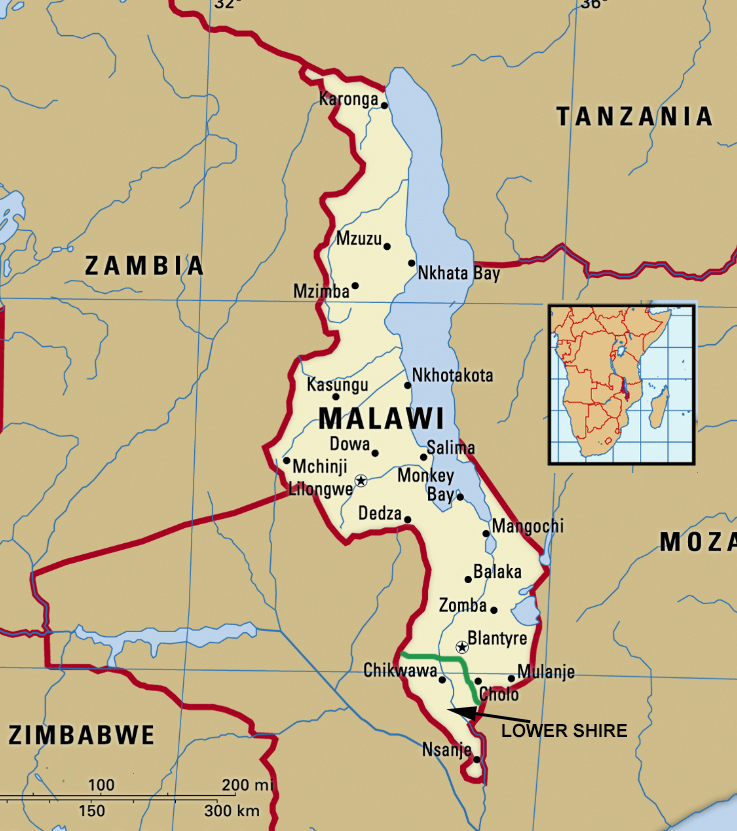
The Lower Shire occupies the Southernmost tip of Malawi comprising the administrative districts of Chikwawa and Nsanje. The Shire River drains Lake Malawi and descends from the highlands around Blantyre through the Lower Shire Valley passing eventually down to join the Zambezi in Mozambique
Whereas most of Malawi has an altitude of approximately 1000 metres rising to 3000 metres (Mount Mulanje), the Lower Shire sits at approximately 100 metres or less above sea level. This elevation, close to sea level, has a significant impact on climate and living conditions.
Malawi is a very poor country and the Lower Shire is the poorest region. Most of the population is reliant on subsistence farming which is very difficult as droughts and floods frequently conspire to reduce crop yields below subsistence level.


Over 50% of the population is at either crisis or emergency levels of food insecurity.
Paradoxically despite having a very large river running through it, the Shire Valley suffers from chronic drought. The low rainfall is rarely enough to grow the staple maize.
Climate change has increased the intensity of the seasonal cyclones resulting in regular serious flooding from the River Shire and flash floods from surrounding hills. Unfortunately the most fertile areas are also the most prone to flooding. The flooding has been made significantly worse by the continuing deforestation of the hills for cultivation. It is said that Malawi’s biggest export is its soil.

Health:
The Lower Shire Valley can be very hot reaching 45C. The Shire River and vast Elephant Marsh create ideal conditions for both Malaria and Bilharzia. The incidence of TB, Respiratory disease and HIV is also very high, particularly amongst the children. Medical facilities are limited and very overstretched.
Historically it has been neglected by both governmental and non-governmental agencies. Staff from both are very reluctant to serve in the Lower River. It always was, and to a large degree remains, a punishment station for both government and private sector employees..